


POLYMER TECHNOLOGY
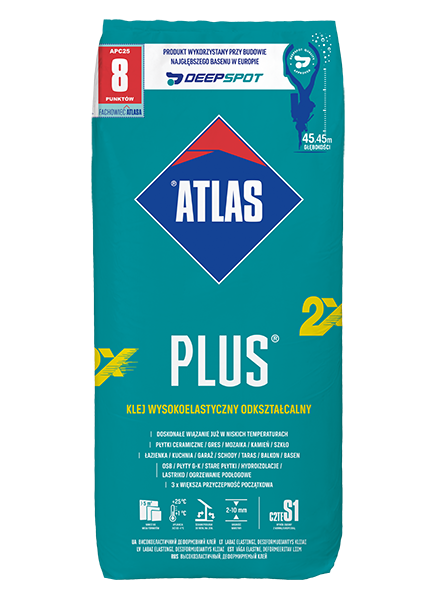
The formulation of the new ATLAS PLUS adhesive uses the ATLAS POLYMER TECHNOLOGY. Thanks to the high content of polymer compounds, the cementitious adhesive obtains unique properties, making it a product with the highest performance parameters, assuring a long-term durability. Due to the polymer content, the adhesive adheres extremely well to substrates and tiles, including substrates that are considered non-standard.
- The use of the POLYMER TECHNOLOGY in ATLAS PLUS gives the following benefits:
- durable and strong bonding of the cladding to difficult and non-absorbent substrates,
- safe to use at temperatures as low as 1 °C – thanks to the setting accelerators, the use of the new ATLAS PLUS adhesive allows the cladding to be walked on after 24 hours, even when installed in insufficiently heated rooms in autumn to spring.
- possibility of use on substrates exposed to high deformation and vibration,
- high resistance to extreme operating loads – mechanical and thermal,
- excellent bonding to all types of tiles,
- safe to use for all tile formats, including tiles with a surface up to 5 m2
- excellent working parameters
ATLAS DOUBLE FIBRES TECHNOLOGY
ATLAS DOUBLE FIBRES TECHNOLOGY is based on a mix of polypropylene and cellulose fibres.
- The polypropylene fibres used in the ATLAS DOUBLE FIBRES TECHNOLOGY are a material with very high chemical resistance to acids, alkalis and solvents or salts. They are hydrophobic, practically non-absorbent, and therefore resistant to microbiological attack. The fibres improve the mechanical properties of the mortar.
- The cellulose fibres become elastic and ductile underwater. They increase their volume and allow the free transport of water along the fibres, thus having a significant effect on the working properties of the mortar. They also keep water in the mortar for longer and therefore aid the bonding process.
The DOUBLE FIBRES TECHNOLOGY in ATLAS PLUS offers the following benefits:
- improvement of strength parameters,
- a significant improvement of resistance to high operational loads, impacts and vibrations,
- safe fixing at large temperature differences,
- compensation of stress occurring on deforming substrates,
- improvement of water retention in the mortar: fibres reduce the result of sudden water absorption by either substrate or a tile as well as within the evaporation zone; during adhesive binding and drying (particularly when applied with maximum coat) the fibres accumulate and transport water and keep its uniform level within the whole coat,
- limitation of the effect of tile “sinking”
- significant improvement of workability
- improvement of tiles’ stability immediately after fixing to the substrate

Reviews
There are no reviews yet.